What Is Performance Marketing? A Guide for Health Practitioners

As a health and wellness practitioner, you want your marketing budget to bring in new clients, not just get your name out there. Pouring money into advertising without seeing a direct return can be frustrating. You might wonder if there is a more efficient way to connect with the people who truly need your expertise. If you're looking for a strategy where you only pay for tangible results, it’s time to understand what is performance marketing.
This approach shifts the focus from paying for ad placements to paying for specific actions, like a potential client booking a discovery call or submitting their contact information. It aligns your marketing spend directly with your practice's growth, offering clarity and control. This guide will walk you through the essential steps to understand and implement this powerful marketing model.
Step 1: Understand the Core Concept of Paying for Results
Performance marketing is an advertising model where you pay only when a specific, measurable action occurs. Unlike traditional advertising, where you pay upfront for ad space or airtime with no guarantee of results, this model is results-driven. The "performance" can be a lead, a sale, a completed form, or a booked appointment. You define the desired action, and you only pay when that action is completed.
Think of it this way: with a traditional magazine ad, you pay a flat fee hoping the right people see it and decide to call you. With performance marketing, you might run a digital ad and only pay the advertising platform when someone actually clicks a link to book a consultation. This direct link between cost and outcome is what makes the model so effective for practitioners who need to justify every dollar of their marketing budget. It removes much of the financial risk associated with advertising.
Step 2: Identify Key Performance Marketing Channels for Your Practice
Several digital channels are well-suited for a performance-based approach. For a health professional, the key is to choose platforms where your ideal clients are actively seeking information and solutions.

Here are some of the most effective channels:
- Pay-Per-Click (PPC) Search Advertising: Platforms like Google Ads allow you to bid on keywords potential clients are searching for, such as "functional medicine doctor for gut health" or "hormone health coach." Your ad appears at the top of the search results, and you only pay when someone clicks on it. This is powerful because you are reaching people with high intent.
- Social Media Advertising: Facebook, Instagram, and LinkedIn have sophisticated targeting options. You can show ads to users based on their demographics, interests (like "holistic health" or "nutrition"), and online behaviors. You can set up campaigns to pay per click (CPC) or per lead generated (CPL).
- Affiliate Marketing: This involves partnering with other websites, influencers, or complementary practitioners. They promote your services to their audience, and you pay them a commission for every client or lead they send your way. For example, a yoga instructor could recommend your nutrition coaching services.
Step 3: See Why Measurable ROI Is the Main Advantage
The primary benefit of performance marketing is its transparency. Every action is trackable, which allows you to calculate your Return on Investment (ROI) with precision. You can see exactly how many leads your campaign generated and how much each one cost. This data-driven approach removes the guesswork from your marketing strategy.
With clear metrics, you can make informed decisions about your budget. If you find that Instagram ads are generating leads for $15 each while Google Ads are costing $40 per lead, you can shift your spending toward the more effective channel. This continuous optimization process ensures your marketing dollars are always working as hard as possible. For many practitioners, this level of clarity provides confidence that their investment is directly contributing to the growth and stability of their practice.
Step 4: Learn the Common Performance Metrics to Track
To manage your campaigns effectively, you need to understand a few key metrics. These numbers tell the story of your campaign's success and highlight areas for improvement.
- Cost Per Lead (CPL): This is the total cost of your ad campaign divided by the number of leads generated. A lead is typically someone who has provided their contact information. Knowing your CPL helps you understand the cost of starting a conversation with a potential client.
- Cost Per Acquisition (CPA): This metric takes it a step further. It measures the total cost to acquire a new paying client. CPA is often the most important metric because it ties your marketing spend directly to revenue.
- Conversion Rate: This is the percentage of people who take your desired action after clicking your ad. For example, if 100 people click your ad and 10 of them fill out your contact form, your conversion rate is 10%. Improving your website's conversion rate is a key lever for making your ad spend more efficient.
- Return On Ad Spend (ROAS): This measures the gross revenue generated for every dollar spent on advertising. A ROAS of 4:1 means you earned $4 for every $1 you spent.
Step 5: Connect Interactive Calculators to Your Performance Strategy
Running a successful performance marketing campaign requires more than just a good ad. When a potential client clicks your ad, they need to land on a webpage that convinces them to take the next step. A generic "contact us" page often isn't enough. This is where an interactive tool can make a significant difference.
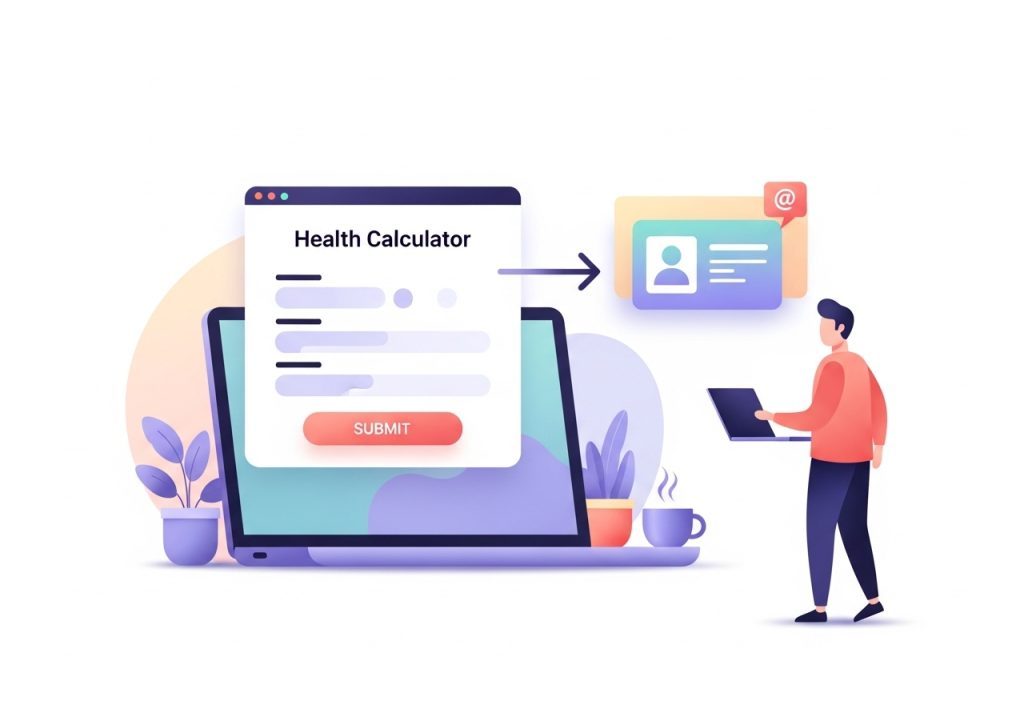
Interactive calculators, like a "Metabolic Health Score" or "Stress Assessment," offer immediate, personalized value. A visitor answers a few simple questions and receives an insightful score and recommendations in return. In exchange for this value, they provide their name and email address. This process transforms a passive visitor into a qualified lead who is already engaged with your approach. By using a calculator as your landing page, you can dramatically increase your conversion rate, which lowers your CPL and makes your entire performance marketing strategy more profitable.
Step 6: Start Your Own Performance-Based Campaign
Getting started doesn't have to be complicated. You can launch a small, focused campaign to test the waters and gather data. Follow these simple actions to begin.
- Define a Clear Goal: What is the one action you want someone to take? It could be downloading a free guide, booking a 15-minute discovery call, or signing up for a webinar. Be specific.
- Know Your Audience: A successful campaign targets the right people. Before you spend anything, it is important to create a detailed customer profile that outlines their pain points, goals, and where they spend their time online.
- Create a Compelling Offer: Your ad and landing page must present a valuable offer. This could be the solution to a specific problem or a piece of valuable information. There are many creative ways to attract customers beyond a simple discount.
- Set Up Tracking: Ensure you have tracking pixels (small snippets of code from platforms like Google or Facebook) installed on your website. This is essential for measuring actions and optimizing your campaigns.
- Start with a Small Budget: You don't need a large budget to start. Begin with a small daily amount, like $10 or $20, to test your ads and landing page. Analyze the data and make adjustments before scaling up your investment.
Performance marketing puts you in control of your client acquisition process. It transforms your marketing from an expense into a predictable, scalable investment. By focusing on measurable actions and continuously optimizing your approach, you can build a system that consistently attracts the right clients to your practice, allowing you to focus on what you do best: helping people achieve better health.
Turn Ad Clicks into Qualified Leads
A successful performance marketing campaign depends on converting traffic into clients. LeadCalculators gives you the tool to do just that. Our interactive, embeddable calculators provide instant value to your website visitors, making them far more likely to share their contact information.
Stop sending valuable ad traffic to static landing pages. Instead, engage potential clients with a personalized assessment, capture their information, and automatically nurture them toward booking a call. See our templates to find the perfect calculator for your practice.